
Noise Monitors, Party Prevention, and Guest Privacy for Short-Term Rentals
Owner Protection Stack
ASTRO does not sell noise monitors, endorse a required provider, or replace an owner's responsibility to follow platform rules, local law, HOA rules, and privacy requirements. Provider names below are examples for owner research, not endorsements. Do not evaluate a company by category label alone. Before buying any product, confirm the exact product, hardware, subscription cost, disclosure language, and platform or PMS integrations.
The core idea
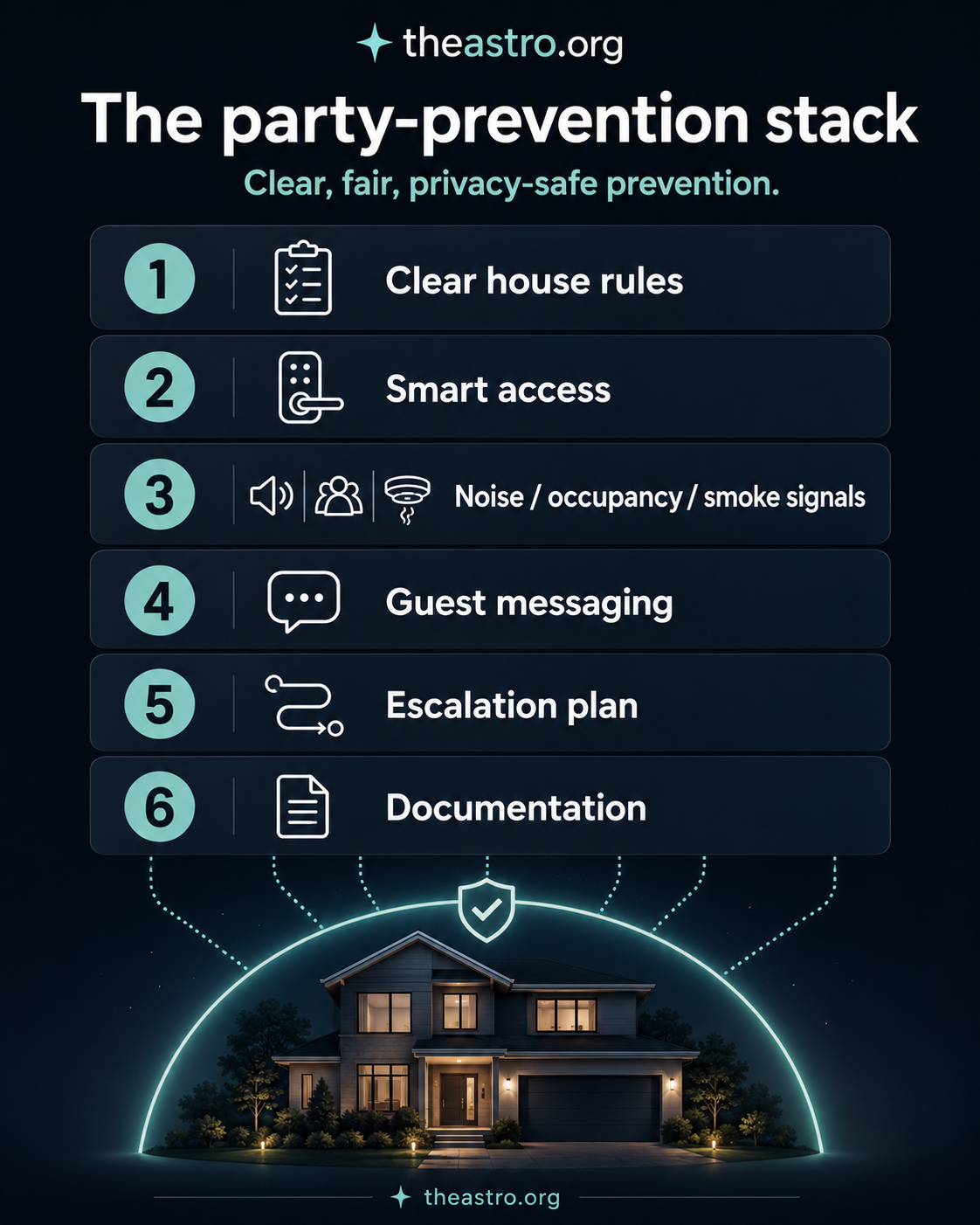
A noise monitor is not a party-prevention strategy by itself. For a short-term rental, party prevention is a stack: clear house rules; occupancy limits; booking-channel expectations; guest screening where appropriate; smart lock and access-code discipline; noise or environmental monitoring; occupancy or crowd-size signals where appropriate; guest messaging; local escalation support; documentation after an incident.
The best system is not the most invasive system. It is the clearest and fairest system: guests know the rules, owners get early warning, and problems are handled before they become claims, complaints, or enforcement events.
The owner problem
Short-term rental owners sit in the middle of several pressures at once. Guests want privacy and a comfortable stay. Neighbors want quiet. HOAs want rule compliance. Cities want responsible operation. Platforms want fewer complaints. Insurers want documentation. Owners want to protect the property without hovering over every stay.
That is why party prevention is so difficult. A loud night can become much more than an awkward message to a guest. It can create neighbor complaints; police calls; HOA fines; city enforcement attention; platform warnings or suspension; property damage; cleaning and turnover problems; chargeback or reimbursement disputes; insurance documentation issues; repeat reputation damage.
At the same time, owners should not overcorrect. A short-term rental is still someone's temporary home. Guests should not feel watched, recorded, or trapped inside a surveillance system. That tension is the whole guide. Good party prevention protects the property without turning normal guests into suspects.
What party prevention actually means
Party prevention is often discussed as if the owner simply needs a device. That is too narrow. A device can alert you that something may be happening. It cannot define your rules, message your guest with judgment, understand your neighborhood, preserve your relationship with neighbors, or decide when escalation is appropriate.
1. Clear rules before booking
Guests should know the expectations before they arrive: maximum occupancy; quiet hours; event and party restrictions; parking rules; pool, deck, balcony, dock, or hot tub hours; pet rules; smoking and vaping rules; local noise ordinance expectations; consequences for violations. A rule hidden in fine print is weaker than a rule stated clearly in the listing, rental agreement, arrival message, and guest portal.
2. Access control
Smart locks and access codes matter because parties often start with access drift. The booking guest receives a code. Then friends arrive. Then extra people come through the door. Access control can help by supporting reservation-specific guest codes; code expiration at checkout; cleaner and vendor codes; access logs; emergency access; removal of stale codes; different handling for direct bookings and OTA bookings. A smart lock does not prevent every party, but it helps reduce uncontrolled access.
3. Noise-level monitoring
Noise monitoring is the most common party-prevention tool. A privacy-safe noise monitor generally measures sound levels or sound patterns. It should not record conversations. It should tell the owner that noise has exceeded a threshold for a period of time, not what the guests are saying. The best moment to fix a noise issue is early. A polite reminder at 10:15 PM is better than a police call at midnight.
4. Occupancy or crowd-size signals
Occupancy monitoring is a different category from noise monitoring. A noise monitor asks: is the property too loud? An occupancy tool asks: are there more people at the property than expected? A party may be forming before it gets loud. But occupancy signals should be treated carefully. They are not guest screening. They do not prove fraud. They are a signal that may justify a human check or a friendly reminder.
5. Smoke, vape, and indoor-air signals
Some monitoring products also detect smoking, vaping, air quality changes, humidity, temperature, or mold-risk conditions. That can be useful, especially for properties with strict no-smoking rules or sensitive interiors. But the category matters. A smoke or air-quality signal is not the same as a noise signal. It needs its own disclosure, rules, and evidence process.
6. Guest messaging
A monitor without a guest communication plan creates stress. Owners should decide in advance what happens after an alert. A good first message sounds human: “Quick reminder: quiet hours begin at 10 PM, and our noise monitor has alerted us that sound levels may be carrying outside. Please bring the volume down so we can avoid neighbor complaints. Thank you.” A bad message sounds hostile: “Violation detected. You are being monitored.” The goal is to correct the behavior, not start a fight.
7. Escalation
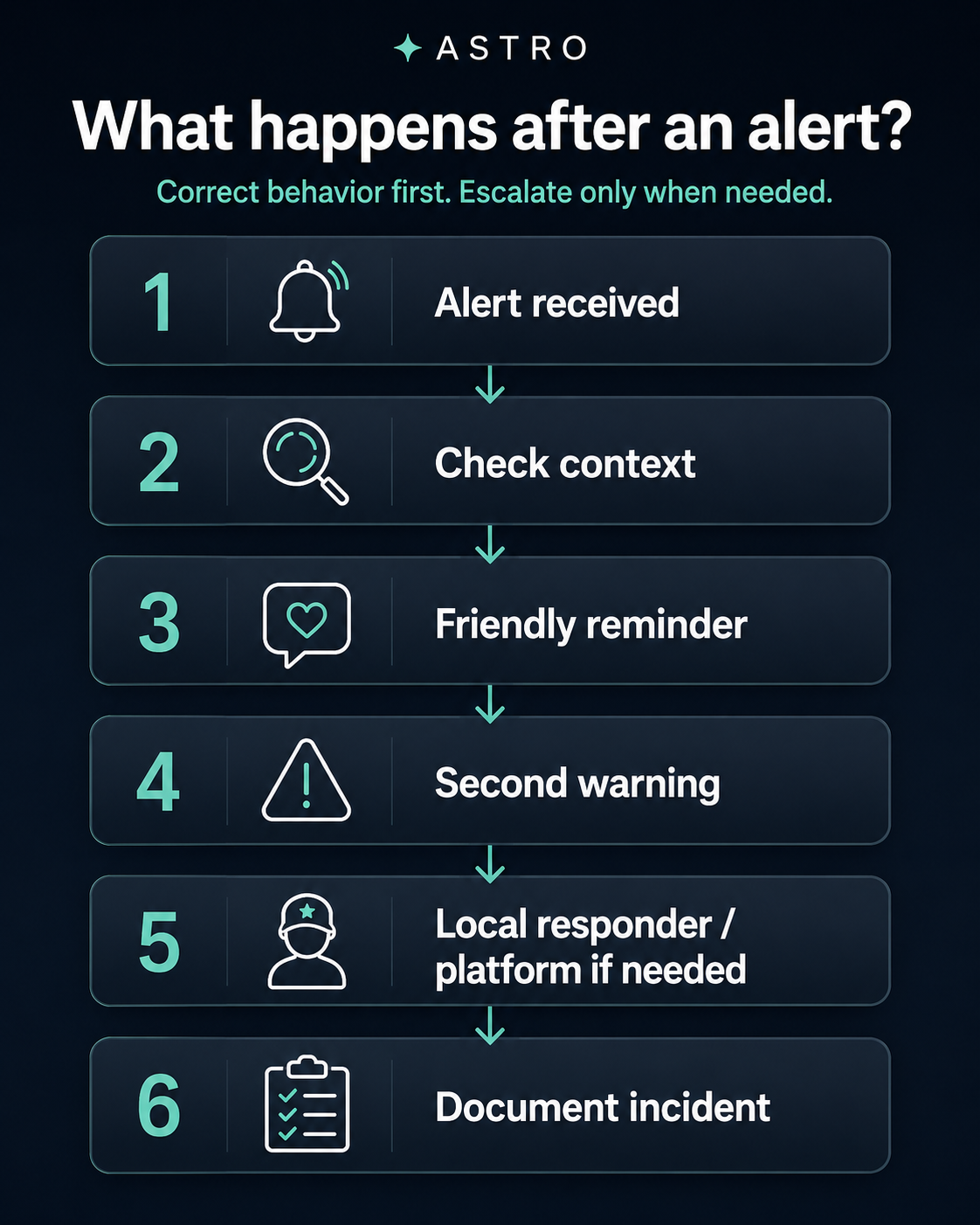
Every owner needs an escalation plan: first friendly message; second firmer warning; call to the booking guest; local co-host or manager check; platform involvement; security vendor or local response, where lawful and appropriate; police or emergency services only when the situation justifies it. Do not invent your escalation plan during the party. Write it before you need it.
8. Documentation
If the situation becomes a platform dispute, insurance issue, HOA complaint, or damage claim, the owner needs records: timestamped noise alerts; occupancy alerts; guest messages; house rules shown to the guest; rental agreement; cleaner notes; photos after checkout; repair receipts; neighbor complaint records; platform case records; incident reports from monitoring tools. The alert is only one piece of evidence. It should support a larger record.
What noise monitors do — and do not do
Noise monitors can be very useful, but owners need to understand the vocabulary.
- A noise monitor measures sound levels or sound patterns; for guest privacy, owners should look for products that do not record audio.
- A decibel threshold is the sound level that triggers an alert — most systems let owners alert if sound exceeds a level, alert only if it stays high for a set period, use different settings during quiet hours, or apply different thresholds indoors and outdoors.
- Sustained noise is more meaningful than a single loud moment — a good alert pattern distinguishes a brief loud sound, a normal family dinner, a loud movie, a dog barking, a true late-night gathering, and outdoor noise that may bother neighbors.
- An indoor sensor may help identify loud gatherings in living rooms, game rooms, kitchens, or common areas — owners should avoid bedrooms and private spaces; the point is property protection, not guest intrusion.
- An outdoor sensor may be more important for properties with pools, hot tubs, decks, balconies, fire pits, patios, docks, outdoor kitchens, shared courtyards, or close neighbors — many neighbor complaints come from outdoor sound.
- A real-time alert gives the owner a chance to intervene early; the right response is not always punishment, often it is a timely reminder.
- An incident report showing timestamps and thresholds can be useful after a dispute, but it is not a complete claim file.
Party prevention is not surveillance
Short-term rental owners need to protect their properties, but they also need to protect guest trust. The privacy boundary should be clear.
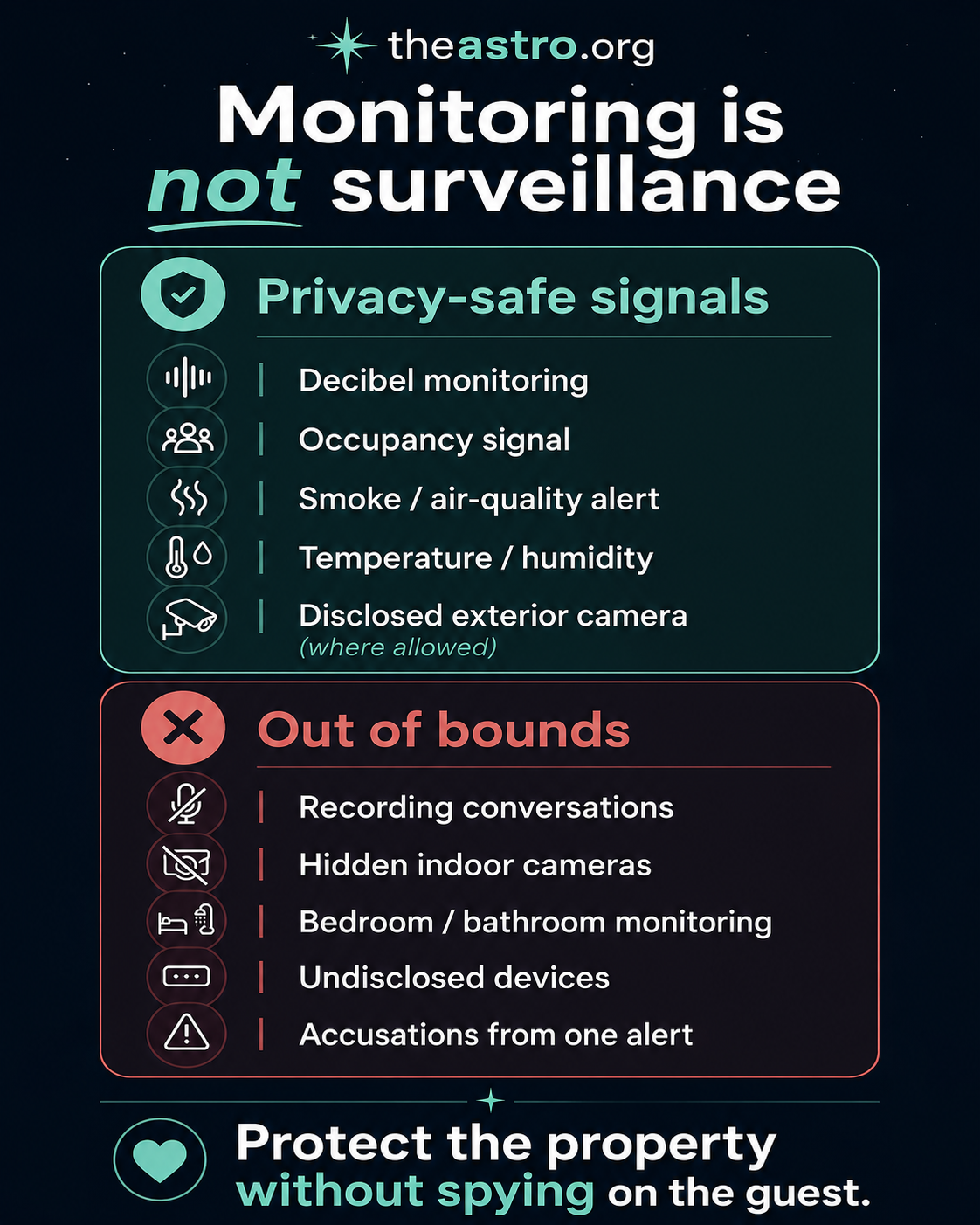
Usually acceptable when disclosed and lawful: privacy-safe noise monitors; decibel monitoring; occupancy or crowd-size signals; smoke or air-quality detection; temperature and humidity monitoring; disclosed exterior cameras where allowed by law and platform rules; smart lock access logs; guest-facing rule reminders. Even then, disclosure matters — follow platform policies, rental agreements, local law, HOA rules, and common sense.
Not acceptable: hidden indoor cameras; cameras in bedrooms or bathrooms; devices that record guest conversations; undisclosed monitoring; misleading “security” language that hides what the device does; monitoring in private spaces; escalation based on suspicion alone.
The rule is simple: protect the property without spying on the guest.
Provider examples: what these companies actually do
The provider names below are examples for owner research, not endorsements. Do not evaluate a company by category label alone. Some products combine noise monitoring, occupancy signals, smoking detection, guest messaging, incident reporting, and integrations. Others focus on one job. Before buying anything, confirm the exact product being offered, the hardware required, the subscription cost, the disclosure language, and the platform or PMS integrations.
Minut
Minut is best understood as a multi-sensor property insight platform. It markets noise, occupancy, smoking, motion/security, temperature, humidity, and indoor-climate monitoring, with an emphasis on property visibility without cameras. Evaluate Minut if you want a broader property-monitoring layer rather than a single-purpose noise alert.
Ask:
- Does it monitor noise only, or noise plus occupancy, smoke, temperature, and humidity?
- Indoors, outdoors, or both? Does it record conversations?
- Can it automate guest messages? Does it integrate with my PMS?
- What happens if Wi-Fi goes down? How are thresholds configured?
- Can different properties have different settings? What reports are available after an incident?
- What must the guest be told?
Owner translation: Minut may fit owners who want a broader operational sensor layer, not just a decibel alert.
NoiseAware
NoiseAware is best understood as a privacy-safe noise and occupancy monitoring product for short-term rentals, with indoor monitoring and an outdoor sensor option. Evaluate it if your main problem is noise control, especially where outdoor noise may create neighbor complaints.
Ask:
- Is the sensor indoor, outdoor, or both? Is the outdoor sensor weatherproof?
- Does the system measure decibels without recording audio? Does it detect occupancy or only noise?
- Can I set quiet-hour thresholds? How fast are alerts?
- Can the guest be notified automatically? What subscription is required?
- Does it integrate with my PMS? What evidence can I export?
Owner translation: NoiseAware is in the classic STR noise-monitoring category, especially relevant when neighbor complaints are the core risk.
Roomonitor
Roomonitor is best understood as a real-time abnormal-noise monitoring product with an operational service angle, emphasizing detecting abnormal noise patterns while respecting guest privacy. Evaluate it if you want real-time noise visibility and a workflow that may fit professional managers or multi-unit operators.
Ask:
- Is this device-only, service-supported, or both? Which markets are supported?
- Does it record audio or only monitor levels? How are alerts handled?
- Can Roomonitor or a manager contact guests? What escalation support is available?
- Individual owners, managers, or both? What data is stored?
- What guest disclosure language is recommended? What evidence can be exported?
Owner translation: Roomonitor may fit operators who want a more managed noise-monitoring workflow rather than a simple alert device.
Alertify
Alertify is best understood as a noise, smoking, occupancy, and indoor-environment monitoring product for vacation rentals, emphasizing sound-level monitoring without recording audio, smoking detection, guest alerts, and incident reports. Evaluate it if you want noise and smoking detection together, especially where smoke, vape, or post-incident reporting matters.
Ask:
- Does it detect noise, smoking, vaping, occupancy, temperature, humidity, or air quality?
- Does it record conversations? How does smoking detection work?
- Can it distinguish cigarette, cannabis, or vaping? What guest-alert automation is available?
- Downloadable incident reports? PMS integration? What documentation helps platform claims?
- How should the device be disclosed? What does the subscription include?
Owner translation: Alertify is in the noise-plus-smoking-monitoring category, valuable when owners need incident documentation, not just alerts.
Party Squasher
Party Squasher is best understood as an occupancy or crowd-size monitoring tool, not a noise monitor. It helps owners identify when too many people may be at the property before the gathering becomes a full party. Evaluate it when the main concern is unauthorized gatherings or extra visitors rather than noise alone.
Ask:
- How does it estimate occupancy? Where is it installed? Does it require Wi-Fi?
- Does it work for my layout? Does it distinguish guests from passersby?
- How quickly does it alert me? Real-time and historical occupancy?
- PMS integration? What should I tell guests? How will I respond to a high-occupancy alert?
Owner translation: Party Squasher is a crowd signal. It can help identify party risk early, but it does not replace guest screening, house rules, or human judgment.
What the warnings actually mean
“Privacy-safe” does not mean “automatically okay.” A device may be designed to protect privacy, but owners still must disclose it properly and check platform rules, local and state privacy laws, HOA rules, rental agreement language, listing disclosure requirements, and guest messaging. Good disclosure is plain: “This property uses a privacy-safe noise monitor that measures sound levels. It does not record conversations.” Bad disclosure is vague: “This property may use monitoring technology.”
Noise alerts are not proof of a party by themselves. An alert means the sound level crossed a threshold. Innocent triggers include loud children, a dropped object, barking dogs, a movie, a birthday dinner, thunder, nearby construction, street noise, moving furniture, or music that is loud but not malicious. Use alerts as a reason to check context, not to accuse. The first response should usually be calm and corrective.
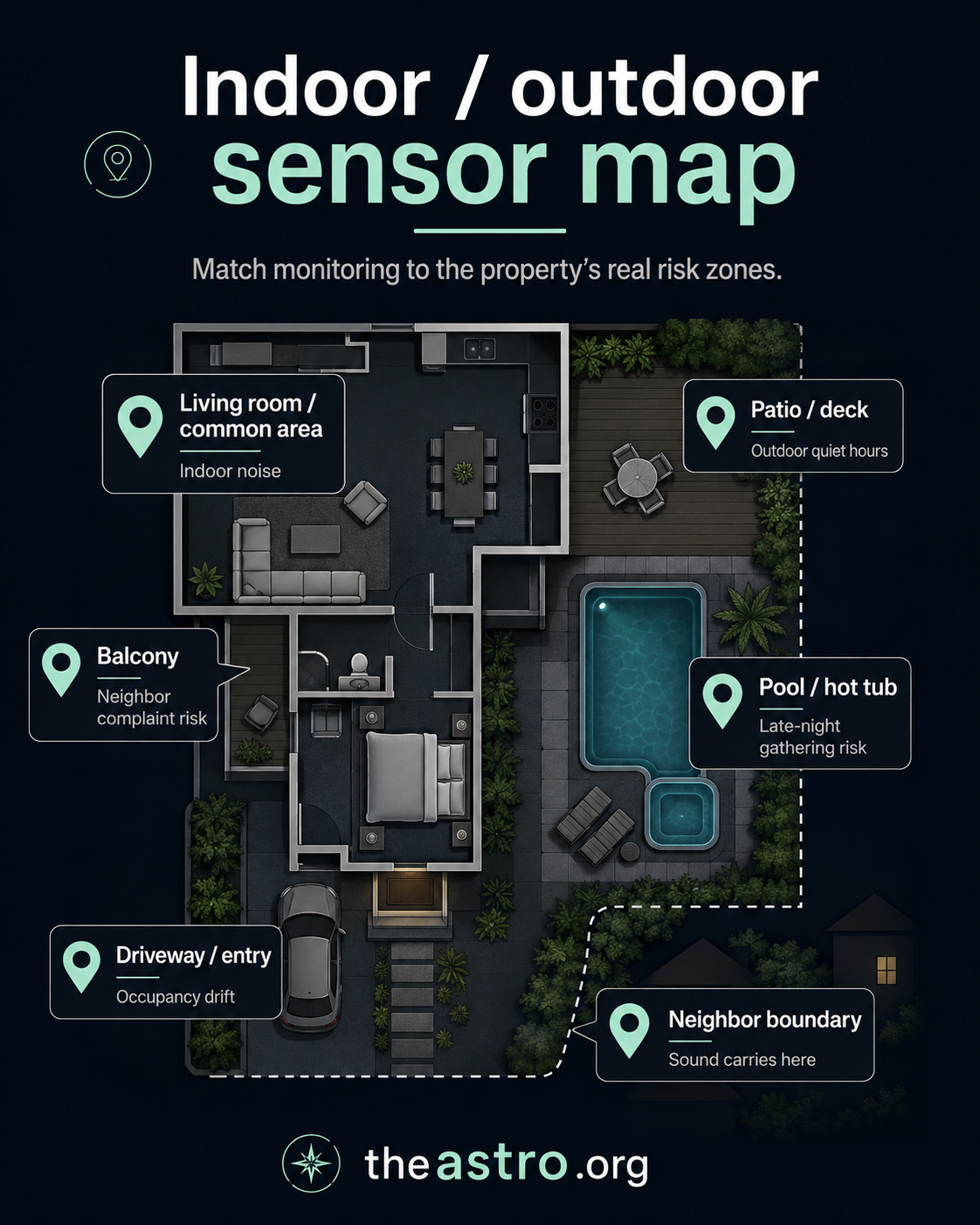
Outdoor noise may matter more than indoor noise. Neighbors complain about what they can hear outside — pool, deck, balcony, patio, fire pit, hot tub, dock, driveway, shared courtyard, outdoor kitchen. A living-room sensor may miss the real problem if guests are outside after quiet hours. Match sensor placement to the property's actual risk.
Occupancy detection is not guest screening. It may tell you more people are at the property than expected. It does not tell you whether the booking guest committed fraud, whether all visitors are staying overnight, whether a rule was intentional, whether the guest misunderstood the limit, or whether the count is exact. It is a signal, not a verdict. A high-occupancy alert may justify: “Quick check-in: our occupancy monitor suggests there may be more visitors at the property than the reservation allows. Please confirm the current guest count and make sure the property stays within the agreed occupancy limit.” That is different from “You are hosting an unauthorized party.”
Automated guest messages need a human tone. A harsh automated message can escalate a minor issue. Bad: “Violation detected. Stop immediately or you will be removed.” Better: “Quick reminder: quiet hours begin at 10 PM, and our noise monitor has alerted us that sound levels may be carrying outside. Please lower the volume so we can avoid neighbor complaints. Thank you.” The goal is behavior correction first.
Wi-Fi failure is a real operational risk. Many monitors depend on Wi-Fi. Ask: Does the device stop monitoring? Store events locally? Alert me that it is offline? Reconnect automatically? Need a power outlet? What happens during a power outage? Can a guest unplug it? Is there tamper detection? A device that silently goes offline is not a reliable prevention layer.
Battery, placement, and tampering matter. Decide where the device belongs; whether the guest can easily unplug it; whether tamper alerts exist; whether cleaners check it during turnovers; whether it is visible enough for disclosure but not intrusive; whether outdoor devices can handle weather. A monitoring system is only useful if it is actually online and correctly placed.
Incident reports help, but they are not enough. Logs or PDF reports can be useful, but should be part of a larger documentation file: timestamped alerts, guest messages, listing/rental agreement language, cleaner notes, photos, invoices, receipts, repair estimates, neighbor complaints, platform case messages. If there is damage, the owner still needs proof of condition before and after the stay.
Platform protection and insurance may require separate proof. A noise alert may support that a gathering occurred; photos may prove broken furniture; cleaner notes may show when damage was discovered; receipts may prove replacement cost; guest messages may show rule warnings; a police report may be required in some cases. Do not assume a monitoring alert alone makes the claim easy.
Disclosure belongs in the listing and house rules. Disclose monitoring in the listing description or house rules, pre-arrival message, rental agreement, Guest Portal or house guide, and on-property signage only if appropriate. Good guests are less upset when the tool is framed honestly: “This property uses a privacy-safe noise monitor to help us respect neighbors and quiet hours. It measures sound levels only and does not record conversations.”
Indoor versus outdoor monitoring
Condo or apartment
Risks: shared walls, hallway noise, balcony noise, building rules, HOA complaints. Focus: indoor common area; balcony/patio if allowed; clear quiet-hour messaging.
Single-family home in a neighborhood
Risks: backyard gatherings, driveway parking, late-night deck or patio noise, neighbor complaints. Focus: living room or common area; patio, deck, pool, or fire pit area; smart lock access history; occupancy signals.
Waterfront, beach, mountain, or cabin property
Risks: outdoor music, fire pit gatherings, hot tub noise, dock activity, large groups, delayed local response. Focus: outdoor areas; occupancy signals; guest messaging; local co-host escalation plan.
Urban party-risk market
Risks: local guests, last-minute bookings, group stays, complaints from neighbors or building management, platform enforcement. Focus: screening; stricter house rules; smart lock discipline; indoor and outdoor noise signals; occupancy signals; fast escalation.
The same product does not solve every property.
Before you buy: owner checklist
Product function
- Does it monitor noise, occupancy, smoking, temperature, humidity, air quality, or a combination?
- Does it record conversations? Have cameras?
- Indoors, outdoors, or both? Support multiple properties? Direct bookings?
- Integrate with my PMS, smart lock, or messaging system?
Guest privacy
- What exactly does it collect? What does it not collect?
- What disclosure language is recommended? Does it comply with platform rules?
- Is it appropriate for the room/area where it will be installed?
- How long is data stored? Can guests see or tamper with the device?
Alerts and escalation
- What triggers an alert? Customizable thresholds? Configurable quiet hours?
- Does it alert owner, manager, guest, or all? Automated guest messages? Editable to sound human?
- What happens after multiple alerts? Can a local contact be included?
Reliability
- Requires Wi-Fi? What happens during a Wi-Fi outage? A power outage?
- Tamper detection? Batteries? Who checks the device during turns? How do you know it is offline?
Documentation
- Incident reports? Exportable? Clear timestamps?
- Noise levels, occupancy indicators, or smoke alerts shown?
- Can reports support disputes or claims? What additional documentation will you still need?
Fit
- Quiet neighborhood, condo building, waterfront, party-risk market, or resort zone?
- Biggest risks indoors or outdoors? Pools, hot tubs, decks, docks, fire pits, shared outdoor areas?
- Are direct bookings part of the business? Is there a local co-host or responder?
- Is the owner comfortable with the guest experience?
A practical party-prevention stack
- Layer 1: Clear rules — maximum occupancy, quiet hours, events policy, smoking policy, parking rules, consequences.
- Layer 2: Smart access — reservation-specific codes, cleaner/vendor codes, checkout expiration, stale-code cleanup.
- Layer 3: Guest screening where appropriate — for higher-risk stays, especially direct bookings, local guests, last-minute bookings, large properties.
- Layer 4: Noise monitoring — privacy-safe decibel monitoring where noise risk actually occurs.
- Layer 5: Occupancy or crowd signals — for large homes, party-risk markets, or outdoor gathering spaces.
- Layer 6: Guest messaging — calm first-warning and second-warning templates before you need them.
- Layer 7: Local escalation — define who responds locally and when.
- Layer 8: Documentation — preserve alerts, messages, photos, reports, receipts, platform records.
The point is not to overbuild; it is to know what happens before, during, and after a problem.
Example guest message templates
First noise reminder: “Hi — quick reminder that quiet hours begin at 10 PM. Our noise monitor has alerted us that sound levels may be carrying outside. Please lower the volume so we can avoid neighbor complaints. Thank you.”
Second noise warning: “We received another noise alert after our first reminder. Please bring the volume down now. Continued noise complaints may require further action under the house rules.”
Occupancy check: “Quick check-in: our occupancy monitor suggests there may be more visitors at the property than the reservation allows. Please confirm the current guest count and make sure the property stays within the agreed occupancy limit.”
Smoking alert: “Hi — we received an indoor air-quality alert that may indicate smoking or vaping inside the property. This is a no-smoking stay. Please stop immediately and use only the allowed outdoor area, if one is provided in the house rules.”
Neighbor complaint response: “A neighbor has contacted us about noise carrying from the property. Please bring the volume down immediately and move any outdoor gathering inside. We want to avoid further complaints or escalation.”
These should be adjusted to match the owner's rental agreement, platform rules, and local law.
The simplest counterargument
The simplest objection is fair: “Do I really need another device? I already have house rules.” Maybe not. A quiet condo with low turnover, strong guest screening, good neighbors, and no outdoor gathering space has a different risk profile from a six-bedroom pool house in a party market. Owners should not buy tools just because vendors make the risk sound scary. A tool should solve a real operational problem. If the owner has never had a noise issue, has close local oversight, does not allow large groups, and has no neighbor pressure, the first step may simply be better house rules, better pre-arrival messaging, and better guest screening. That is reasonable.
What still matters
The counterargument does not eliminate the risk. One bad event can be expensive. Noise and party-prevention tools are most useful when the property hosts groups; has outdoor amenities; neighbors are close; local rules are strict; the owner is remote; the property accepts direct bookings; the owner has had prior complaints; the property is in a party-risk market; or the owner needs better documentation.
The right question is not “Should every owner buy a noise monitor?” but “What early-warning system does this property need, and how do we use it without violating guest trust?” For some owners, the answer is a device. For others, it is better rules, better screening, better access control, or a local responder. For many, it is a combination.
Where this shows up in ASTRO
ASTRO is built for short-term rental owners. Party prevention is not just a device category; it is part of responsible property operation. Owners who participate in a verified network need to think clearly about property identity; guest-facing rules; neighbor relationships; direct booking posture; owner-network stays; local services; insurance documentation; property reputation.
ASTRO does not sell noise monitors, endorse a required provider, or replace an owner's responsibility to follow platform rules, local law, HOA rules, and privacy requirements. ASTRO's role is to help owners ask better questions. For party prevention, the owner-first position is simple: use the least invasive system that solves the real risk. Good prevention protects the owner, the property, the neighbor, and the guest. When you are ready to align property identity with how you operate, explore the registry or join ASTRO.
Bottom line
Noise monitors can help short-term rental owners prevent problems before they become complaints, claims, or enforcement events. But a monitor is only one layer. A serious party-prevention strategy includes rules, access control, monitoring, messaging, escalation, and documentation. The best system is not creepy. It is clear. Guests know the rules. Owners get early signals. Problems are handled quickly. Neighbors are respected. The property stays protected. That is the standard.