
The Safe and Durable Property: How to Build a Short-Term Rental That Rarely Needs a Claim
What owners need to understand before something goes wrong
Most owner conversations about risk start in the wrong place. They start with coverage — which policy, which platform protection, which damage product, which deposit. All of that matters, and it is the subject of its companion guide, Short-Term Rental Insurance: The 5-Layer Protection Stack. But coverage is what you reach for after something has already happened. By then the guest is hurt, the floor is ruined, or the claim deadline is ticking.
There is an earlier, cheaper, and more reliable place to spend your attention: the property itself.
A safe and durable property is a best-effort attempt to avoid claims entirely. Every hazard you remove is a liability claim you will never file. Every durable choice you make is a damage claim — or a deposit dispute — that never happens. Prevention is not glamorous and it does not come with a policy number, but it is the only layer of protection that pays you back on every single stay, not just the bad ones.
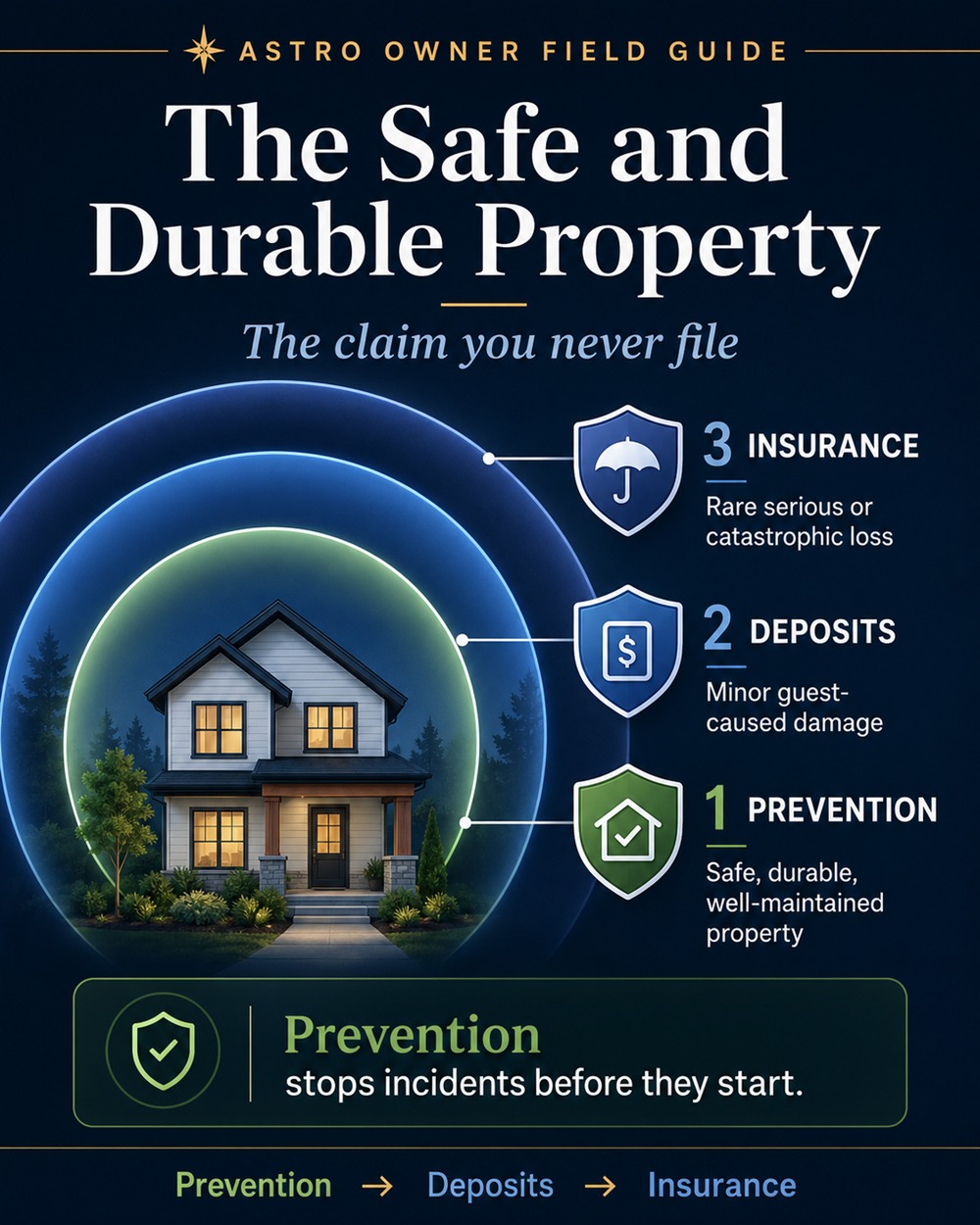
Think of it as a stack with the right order of operations:
- Prevention — a safe, durable, well-maintained property. This guide. The layer that stops incidents before they start.
- Deposits — first-dollar recovery for minor, guest-caused damage. See the sister guide, Short-Term Rental Security Deposits.
- Insurance and the protection stack — the backstop for the rare, serious, or catastrophic loss. See the 5-layer protection stack guide.
The protection stack guide ends with a simple line: the worst time to read exclusions is after a claim. This guide is the corollary. The best time to prevent a claim is before a guest ever walks through the door.
Tension: insurance pays for the loss, but it doesn't undo it
Common bad assumption:
"I'm well insured, so I don't need to worry about how the place is built or maintained."
Insurance reimburses money. It does not give you back the lost nights while the property is repaired, the deductible you pay out of pocket, the time spent documenting and filing, the guest review that mentions the broken step, or — in the worst cases — the premium increase or non-renewal that follows a claim history. A property that generates frequent small claims and the occasional large one becomes more expensive to insure and, eventually, harder to insure at all.
Prevention and coverage are not substitutes. They are sequential. A safe and durable property lowers the odds that you ever touch your deposit or your policy, and keeps your loss history clean so the protection stack stays affordable and available when you genuinely need it.
Treat the building as your first layer of protection, not an afterthought to the paperwork.
The two questions this guide answers
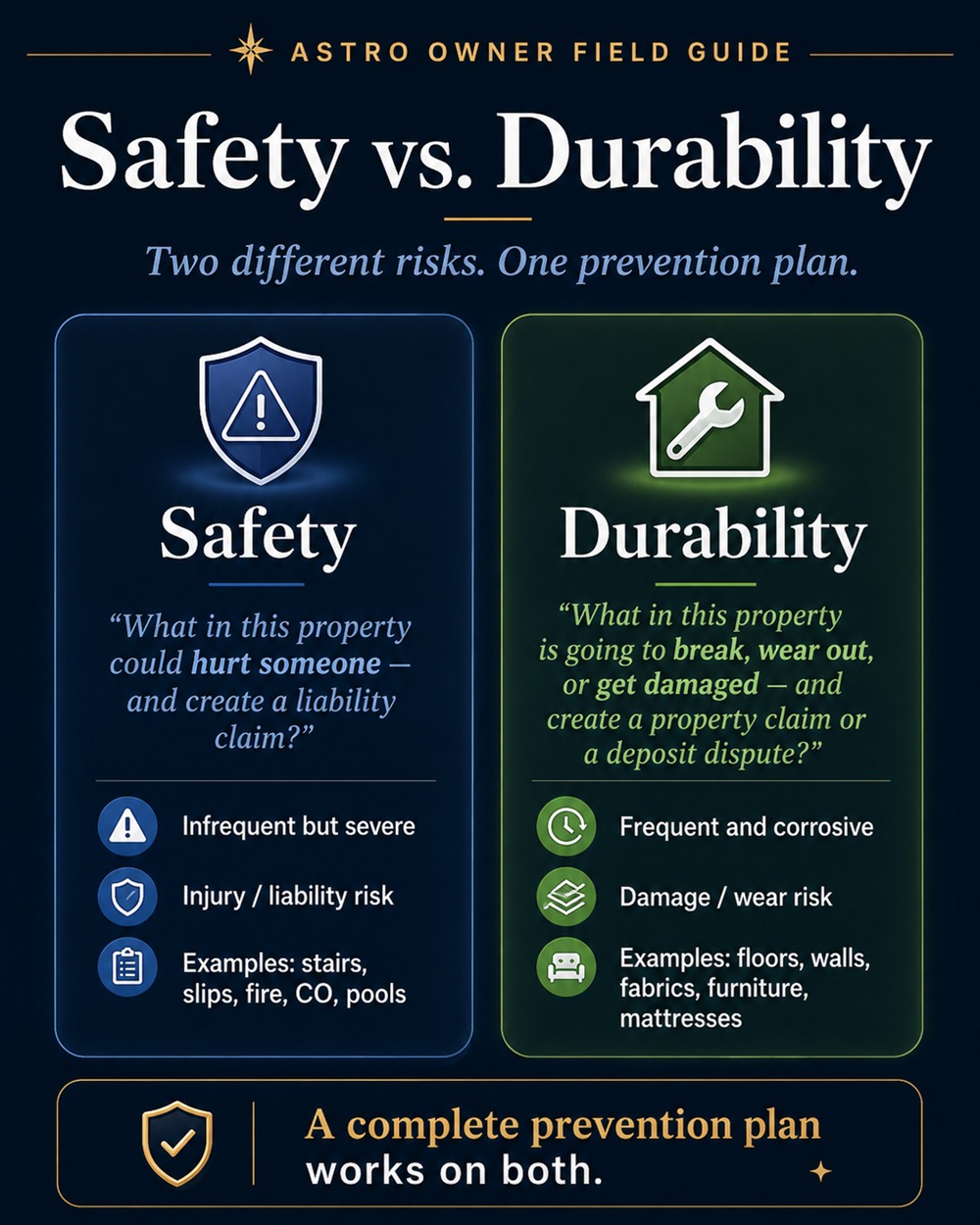
A safe and durable property answers two different risk questions, and it helps to keep them separate.
Safety: "What in this property could hurt someone — and create a liability claim?"
Durability: "What in this property is going to break, wear out, or get damaged — and create a property claim or a deposit dispute?"
Injury claims tend to be infrequent but expensive and slow. Damage claims tend to be frequent, smaller, and corrosive to both your margins and your guest relationships. A complete prevention plan works on both.
Part 1 — A safe property: preventing the injury claim
Liability is where short-term rental risk gets serious. A damaged sofa is an annoyance. A guest injured on your stairs, in your pool, or by your water heater is a different category entirely — and it is exactly the kind of loss the core property and liability layers of the protection stack exist to catch. Your job here is to make sure they rarely have to.
Walk the property as a stranger would
The single most useful exercise is to walk your property as if you had never been there, at night, possibly tired, possibly with a drink in hand, possibly with children. Hosts stop seeing their own hazards because they have learned to step over them. Guests have not.
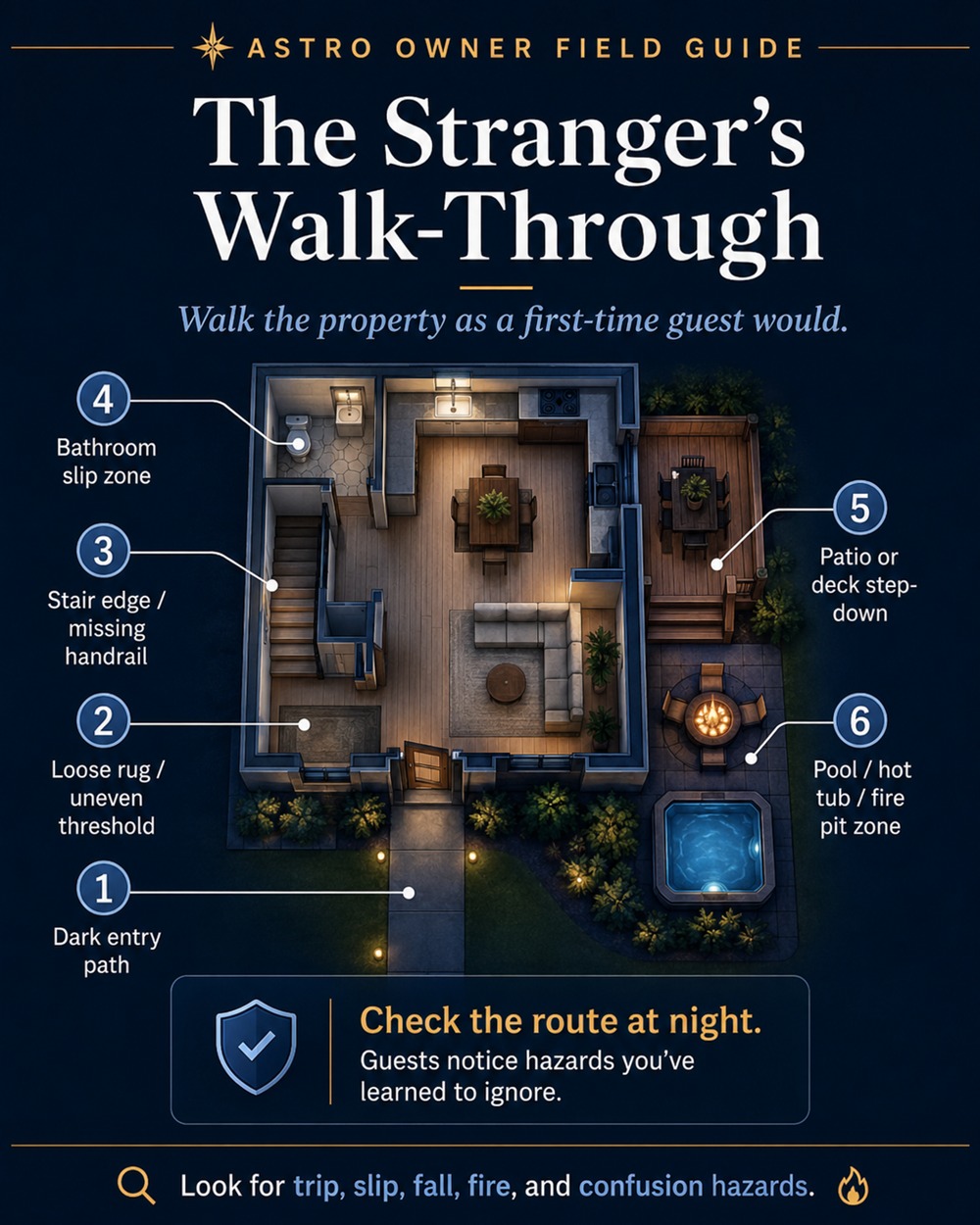
Look for the predictable injury sources:
- Trips and falls — uneven thresholds, loose rugs, dark stairwells, missing or wobbly handrails, steps that aren't obvious, cords across walkways, slick entries when wet.
- Stairs and railings — secure handrails on both sides where practical, even risers, adequate lighting, and visible edges. Stairs are one of the most common serious-injury sources in any home.
- Lighting — every path a guest takes after dark: entry, stairs, hallways, bathrooms, around amenities. Motion or always-on lighting at transitions removes a whole class of falls.
- Slip zones — bathrooms, tubs and showers, tile entries, decks, and pool surrounds. Non-slip surfaces, mats, and grab bars where appropriate.
The high-consequence systems
Some hazards are rare but severe enough to deserve dedicated attention:
- Fire — working smoke alarms in the right locations, tested on a schedule with fresh batteries; an accessible, in-date fire extinguisher; clear exit information; caution around space heaters, candles, fireplaces, and overloaded outlets.
- Carbon monoxide — CO alarms wherever there is combustion (gas appliances, fireplaces, attached garages). CO is invisible and the failure mode is catastrophic.
- Electrical and water heating — no obviously overloaded circuits or damaged cords; water heater set to a temperature that avoids scald risk; GFCI protection in wet areas.
- Amenities — pools, hot tubs, docks, fire pits, trampolines, and similar features are the highest-liability items in the property. The protection stack guide is explicit that undisclosed amenities can void coverage, so safety and disclosure travel together: appropriate barriers, signage, rules, depth markers, covers, and clear instructions, and written disclosure to your carrier.
Reduce misuse with clear information
A surprising share of injuries and damage comes from guests using something they didn't understand — the wrong setting on the hot tub, the fireplace they didn't know was decorative, the steep step down to the patio. A clear, current house manual is a safety device. It is also part of the documentation trail your insurer and your deposit process both rely on; the protection stack guide covers that documentation discipline in detail.
Part 2 — A durable property: preventing the damage claim and the deposit dispute
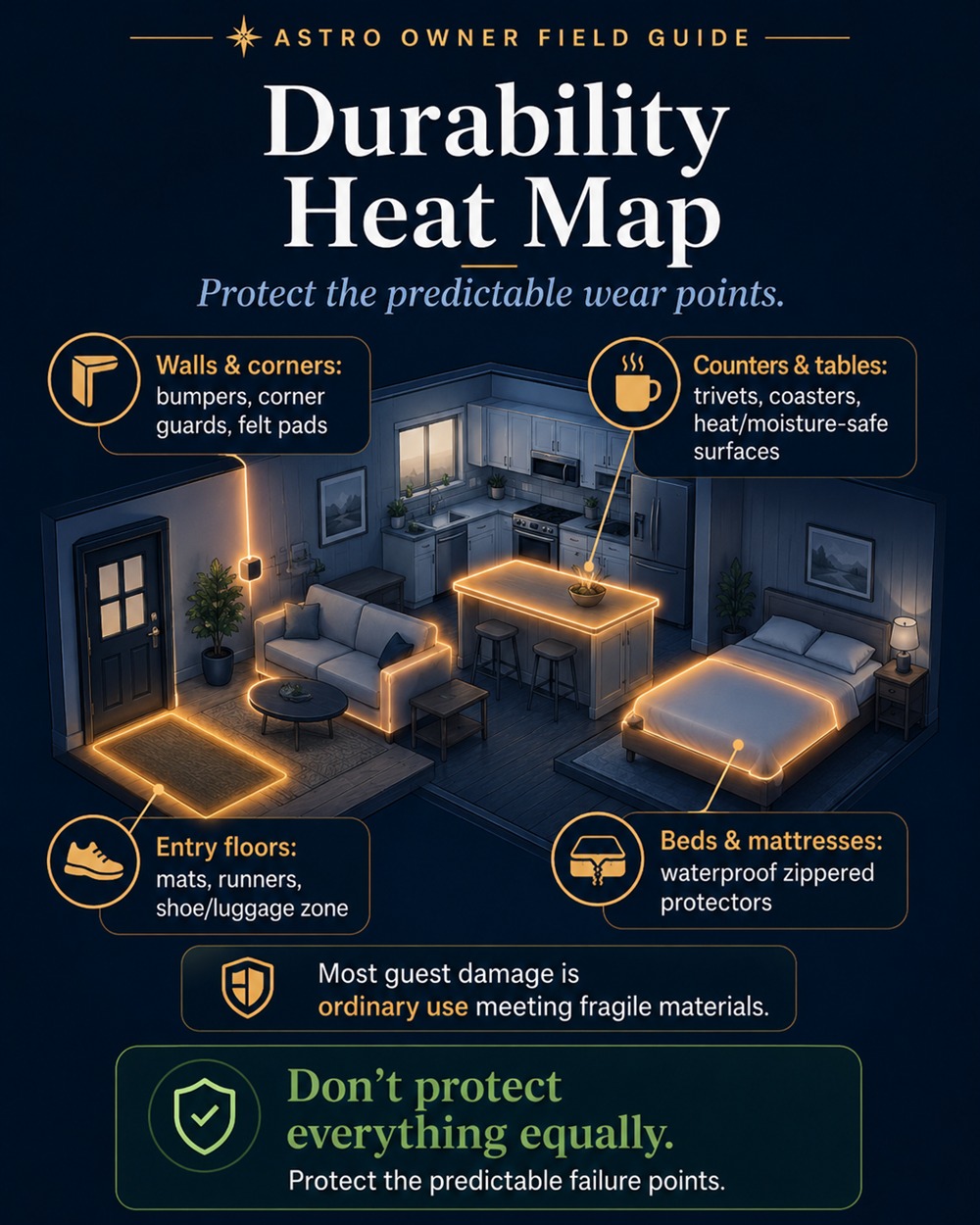
Durability is where you win the everyday battle. Most guest-caused damage is not malice; it is ordinary use meeting fragile materials. The fix is to build and furnish for the use the property actually gets — high turnover, strangers, luggage, kids, the occasional spill — rather than for how you'd live in it yourself.
When durability fails, the cost lands in one of two places: your deposit (for minor, attributable, guest-caused damage) or, for larger losses, your policy. Building durably shrinks both. For how the deposit layer actually works — what's claimable, how to document it, and how to handle disputes — see the sister guide, Short-Term Rental Security Deposits. This guide stays focused on making the deposit rarely necessary in the first place.
Choose materials and finishes for hard use
- Floors — hard-wearing, water-tolerant surfaces (luxury vinyl plank, tile, sealed hardwood) survive turnover far better than light carpet. Where you want softness, use washable, replaceable rugs over a durable base.
- Walls — washable or scrubbable paint in mid-tone, forgiving colors; consider semi-gloss or satin in high-traffic zones. Touch-up paint stored on-site turns a "claim" into a five-minute fix.
- Fabrics — performance or stain-resistant upholstery, removable and washable covers, darker or patterned fabrics that hide wear. A wine spill on a white linen sofa is a deposit dispute; on a performance-weave sectional it's a wipe-down.
- Furniture — commercial- or contract-grade where you can, solid construction over particleboard, and pieces you can repair or replace a component of rather than discard whole.
Protect the predictable wear points
Damage clusters in the same places in every property. Get ahead of it:
- Entry zones and floors near doors — mats, runners, and a place for shoes and luggage.
- Walls behind furniture and at corners — bumpers, corner guards, felt pads under everything that moves.
- Counters and tables — trivets, coasters, and surfaces that tolerate heat and moisture.
- Beds and mattresses — waterproof, zippered protectors on every mattress and pillow. This is one of the highest-return durability purchases you can make.
Remove what shouldn't be at risk in the first place
The most reliable way to avoid a claim over a broken or stained item is for that item not to be there. A short-term rental is not the place for heirlooms, irreplaceable art, sentimental objects, or fragile décor that can't be cleaned or replaced cheaply. If losing it would genuinely hurt, it doesn't belong in a rental.
Maintenance is durability over time
A durable property that isn't maintained quietly becomes a hazardous one. The small leak becomes the water-damage claim; the loose railing becomes the injury claim; the worn step becomes the fall. A simple, repeatable maintenance and inspection rhythm — between stays for the basics, seasonally for the systems, and after any incident — is how prevention holds up across a hundred guests instead of the first ten.
Owner action plan: what to do this week
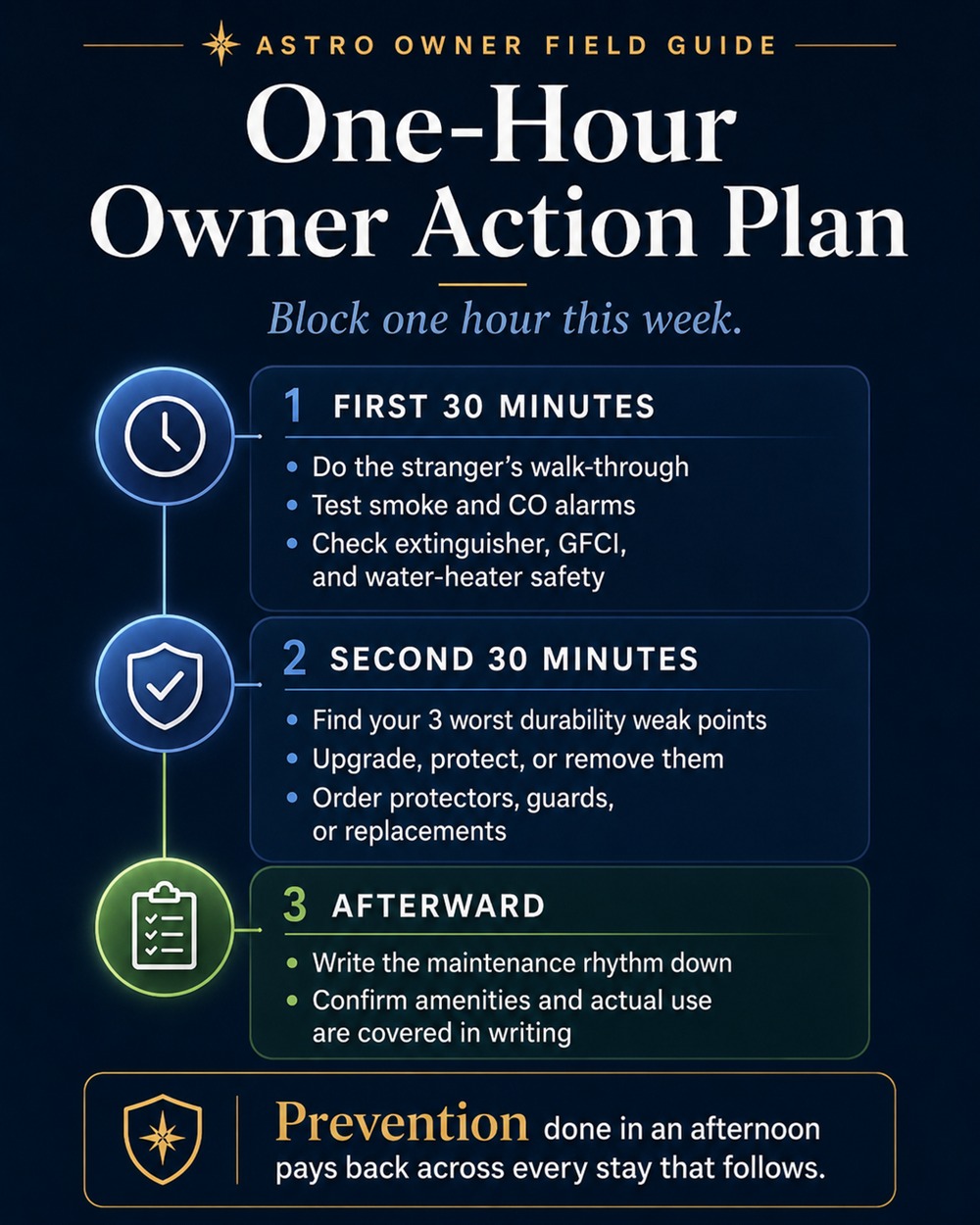
1. Do the stranger's walk-through
Walk the property end to end as a first-time guest, ideally at night. Write down every trip, slip, fall, fire, and confusion hazard you find. Fix the cheap ones immediately; schedule the rest.
2. Verify the high-consequence systems
Test every smoke and CO alarm. Check the fire extinguisher's date and location. Confirm GFCI protection in wet areas and a safe water-heater temperature. These are low-cost checks against your highest-consequence losses.
3. Bring amenities into the light
For every pool, hot tub, dock, fire pit, or similar feature, confirm the barriers, signage, rules, and instructions are in place — and confirm in writing that your carrier knows the amenity exists. Undisclosed amenities are a coverage gap; see the protection stack guide.
4. Find your three worst durability weak points
Identify the three most likely things to get damaged — usually a light floor, a delicate sofa, an unprotected mattress, or a fragile valuable that shouldn't be there. Upgrade, protect, or remove them.
5. Write the maintenance rhythm down
Turn maintenance from memory into a checklist: per-turnover basics, seasonal systems, and post-incident reviews. A written rhythm is what keeps a property safe and durable on stay one hundred, not just stay one.
6. Connect prevention to your coverage and deposit
A safe, durable, well-documented property strengthens both backstops. Review how your deposit handles the minor damage you couldn't prevent — see the deposits guide — and confirm your insurance protection stack matches how the property is actually built, operated, and amenitized.
Where this shows up in ASTRO
ASTRO is built for short-term rental owners, but ASTRO does not inspect properties, certify safety, enforce building or fire codes, perform maintenance, or guarantee that any property is safe or durable. ASTRO does not sell insurance and does not hold or administer guest deposits in this release.
ASTRO's role is to help owners operate with clearer identity, registry, trust, and owner-program boundaries — and to share practical owner education like this guide.
- Explore properties — registry identity and trust posture.
- Join ASTRO — membership and property claim workflows.
- Verification ladder — listing-control and verification stages (member session required).
- Owners Exchange — when you host other verified owners, the same prevention discipline protects your property; exchange mechanics are separate from insurance and deposits.
Keeping a property safe and durable is owner operating practice. It is not an ASTRO certification, and nothing in this guide is a substitute for licensed inspection, your local codes, or your own coverage.
Operator Reality
Block one hour this week. Spend the first half doing the stranger's walk-through and testing your alarms; spend the second half identifying your three biggest durability weak points and ordering the protectors, guards, or replacements. Then pull your declarations page and confirm — in writing — that your amenities and actual use are covered, exactly as the protection stack guide recommends. Prevention done in an afternoon quietly pays back across every stay that follows.
Common mistakes owners make
- Treating insurance as a reason to skip prevention, when the two are sequential, not interchangeable.
- Furnishing the rental the way they'd furnish their own home — with fragile, light, or sentimental items that can't survive turnover.
- Ignoring amenities, the single highest-liability feature, both for safety and for carrier disclosure.
- Letting maintenance slip until a small issue becomes a large claim.
- Skipping the documentation that both the deposit and the insurance layers depend on.
- Assuming "guests will be careful," rather than designing for ordinary, uninformed use.
The Simplest Counterargument
Some owners will say prevention is over-engineering. Most stays end without incident. Performance fabrics, corner guards, contract-grade furniture, amenity barriers, and maintenance schedules all cost money and effort up front, and a careful owner with good guests may go years without a meaningful claim either way. Why not just carry good insurance and a reasonable deposit, and handle problems as they arise?
That objection is fair. Prevention has real, immediate costs, and not every property faces the same exposure. A studio with no amenities and a quiet guest profile does not need the same hardening as a waterfront home with a pool and large groups.
What Still Matters
Not every property needs every measure. The right amount of prevention depends on the property, the amenities, the guest profile, and the owner's tolerance for the occasional loss.
But prevention is the only layer of protection that works on every stay rather than just the bad ones, and it is the layer that keeps the other two — deposits and insurance — affordable, available, and rarely needed. The goal is not a fortress. The goal is a property where the predictable hazards have been removed and the predictable damage has been designed out, so that when something does go wrong, it is the exception your backstops were built for — not the routine cost of doing business.
Make the safe, durable choice once, and you stop paying for it on every stay afterward.
Editorial notice
This guide is educational only. It is not safety, engineering, legal, insurance, or code-compliance advice. Building codes, fire and life-safety requirements, amenity regulations, and landlord-tenant and short-term rental rules vary by jurisdiction, property type, and amenities. Every owner is responsible for meeting their own local requirements and should consult licensed professionals — inspectors, electricians, pool and spa specialists, and their own insurance carrier — for their specific property. ASTRO does not inspect, certify, or guarantee any property's safety or condition.
Related owner reading
- Short-Term Rental Insurance: The 5-Layer Protection Stack — the backstop for serious loss.
- Short-Term Rental Security Deposits — first-dollar recovery for minor, guest-caused damage.
- All owner field guides
- Owner playbooks
- Support