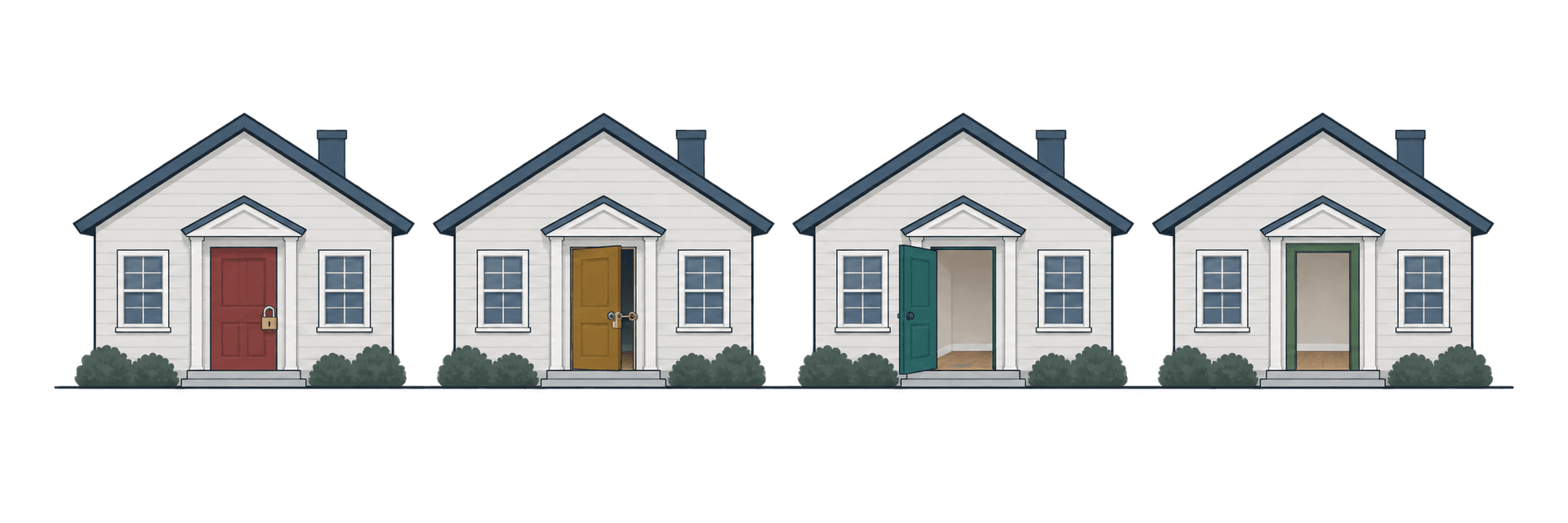
A short-term rental is when someone rents out a house or a room for a few nights, like on Airbnb. Every city writes its own rules for them. But almost every city reaches for the same short list of levers. Once you can name the lever, you can tell how strict a city is — usually in about five minutes.
Part of City Watch, where we rate every city we can from the real rules.
Restrictive
The door is locked. You can't run a whole-house rental in normal neighborhoods.
Regulated
The door opens, but you need a permit first — like a fishing license.
Light-touch
The door is open. You just sign in or pay a small tax.
Unrestricted
There's no door at all. The city has no rule about it.
◀ HardestEasiest ▶
The levers of control
Nine ways cities, counties and states restrict or protect property owners
A city’s rating comes from its single strongest rule. So read from the top. The first rule that shuts the door decides everything — once you find it, you can stop. Each card tells you what the rule does, the words that give it away, and a real town that uses it.
The city only allows rentals in certain spots — like downtown or near the hotels. Regular neighborhoods aren't on the list. And no permit can fix a use the neighborhood isn't zoned for.
Words to look for
the zoning list"lodging""tourist"a blank spot for your zone
Where you’ll see itCorvallis, OregonA whole-house rental with no owner around counts as "lodging" — and lodging isn’t allowed in any neighborhood.
Only so many allowed
a.k.a. a cap or a freeze
The city sets a limit — say 293 rentals. Once they're full, nobody new gets in. Getting on a waitlist is still standing outside a closed door.
Words to look for
"cap""maximum number""shall not exceed""moratorium""waitlist"
Where you’ll see itPortland, MaineOnly so many rentals owned by people who don't live there are allowed — 293 for 2026 — and it's full, so new ones wait in line.
You have to live there
a.k.a. primary-residence-only
You can only rent out the home you actually live in. A house you bought just to rent out doesn't count. Usually you have to live there most of the year to prove it.
Where you’ll see itBellingham, WashingtonIn a neighborhood, you can rent out your place only if you live there most of the year — at least 270 days.
Just a few days a year
a.k.a. a day cap
You're allowed to rent — but so few days that it can't really be a business. A limit like 25 days a year closes the door in a quieter way.
Words to look for
"no more than ___ days""per year""per calendar year"
Where you’ll see itClemson, South CarolinaYou can rent a home no more than 25 days in a whole year. That's too few to run a rental business.
You have to ask, and they can say no
a.k.a. a special permit
There's no clear yes-or-no rule. Instead, a board looks at your case and decides. And they're allowed to turn you down. A door someone can shut in your face isn't really open.
Words to look for
"conditional use""special exception""special use permit""board"
Where you’ll see itChesapeake, VirginiaA rental is only allowed in two special districts, and only if a board says yes. Everywhere else, it's a no.
Level 2Regulatedrentals are allowed, but you need a permit first
Get a permit first
a.k.a. a rental permit
You sign up, pay a fee, and pass a safety check. But whole-house rentals really are allowed — no limit, no neighborhood ban. It's a real rule, just not a wall.
Words to look for
a whole rental chapter"registration""a permit will be issued"and no wall above
Where you’ll see itPullman, WashingtonYou need a permit and a safety inspection. But whole-house rentals are allowed in neighborhoods, with no limit.
Level 3Light-touchjust some light paperwork, or a tax
Just sign in
a.k.a. a basic license
The same simple paperwork any business fills out — a form and a small fee. Nothing special about rentals. It's a sign-in sheet, not a gate.
Where you’ll see itCrystal River, FloridaThe state canceled the town's stricter rule, so the only thing left is the basic business license everyone gets.
Pay the visitor tax
a.k.a. a lodging tax
The city or county charges a tax on overnight stays. That tax covers rentals too, even when the zoning rules say nothing. To find it, check the tax pages, not the zoning pages.
Words to look for
"occupancy tax""hotel tax""tourist tax""six months or less"
Where you’ll see itOuter Banks, North CarolinaDare County charges a tax on short stays in cottages and homes. There's no other rule behind it — just the tax.
Level 4Unrestrictedno rule at all — and you checked to be sure
No rule at all
a.k.a. nothing on the books
Some places just have no rules — and a few couldn’t make one even if they wanted to. But "I didn’t find a rule" isn’t the same as "there is no rule." You have to check and be sure.
Words to look for
no rental rulesno visitor taxa place that can't make zoning rules
Where you’ll see itLake Travis, TexasThis is county land, and Texas counties aren't allowed to make zoning rules — so there's no rental rule to find, and the tax isn't collected.
Where the real rules live
Only some sources can settle it
A rule is only as good as the place you found it. Before you trust a rule, sort where it came from. A blog can point you to a rule, but it can’t be the rule.
Can settle it Trust these
The real rule, in the words of the people who made it.
The city’s online code book — on sites like Municode or eCode360
The city or county’s own website
The actual law that passed, or the state law
Just a hint Don’t trust alone
Handy for finding a rule fast — never for proving one.
Rental blogs and permit-lookup sites
News stories about a city vote
A lawyer’s opinion about a rule (it describes; it doesn’t make the rule)
Three pages hold most of the answers
The zoning listWhich neighborhoods allow a rental, and which leave it off.
The definitionsHow the code spells out words like "rental" and "home." The whole thing rests on these.
The tax pageWhether a visitor tax covers rentals — the clue the zoning pages never show.
Easy mistakes
Six ways to get it wrong
Most wrong answers don’t come from missing a rule. They come from trusting a rule that isn’t really in force. These are the ones that trip people up.
01
A rule that was only an idea
Someone talked about it, but the city never passed it. One Texas town's “rental license” was really a rule about signs, and the rest came from an old draft that got dropped years ago.
02
A rule the state canceled
A state can overrule its cities. Florida only keeps rental rules that were in place before June 2011. Texas counties can't make zoning rules at all. A rule can be sitting in the book and still be dead.
03
A rewrite that reset the clock
When a city rewrites its whole rulebook, an old rule gets a new date. In a state like Florida, that new date can cost the rule its protection — so a rewrite can quietly loosen the rules.
04
A hotel tax that skips small homes
Some hotel taxes only count places with "six or more rooms." That kind of tax misses a single house — so it doesn’t count as a rule for rentals. Read what the tax actually covers, not just its name.
05
The county's tax isn't the city's
For a city, a tax the county charges isn't the city's own rule. Only a tax the city itself charges counts for the city. (An area with no city of its own does ride on the county's tax.)
06
A rule that starts next year — or a whole region
If a rule hasn’t started yet, it doesn’t count today. And a name like "Lake Travis" or "Outer Banks" is a whole region, not one town. Find the town or county in charge before you read any rulebook.
Put it together
Figure out a town in five steps
Go in order. The first blocking rule you hit sets the level — you don’t have to finish the list.
1
Find who's in charge
Is it a city, or open county land with no city? Watch out for names that cover a whole region instead of one town.
TELLS YOU · whose rulebook and whose tax to read
2
Look at the zoning list
Can a whole-house rental happen in normal neighborhoods? If it's left off the list, or needs special approval, the door is locked.
LEFT OFF / ASK-FIRST → Restrictive
3
Look for a hard limit
A cap, a freeze, a “you have to live there” rule, or a tiny days-per-year limit. Any one of these locks the door.
ANY ONE → Restrictive
4
Look for a rental permit
If rentals are allowed but you need a real sign-up and safety check, that's a permit. If it's just the same paperwork every business fills out, it's lighter than that.
RENTAL PERMIT → Regulated · BASIC ONLY → Light-touch
5
Check the tax page
A visitor tax that covers rentals means at least Light-touch. Nothing at all — no rule, no tax — and you've really checked?
TAX ONLY → Light-touch · TRULY NOTHING → Unrestricted
Want the answer for your town?
We do this work city by city — reading the real rulebook, checking it at the source, and sorting each place into one of these four levels. See where your town lands.